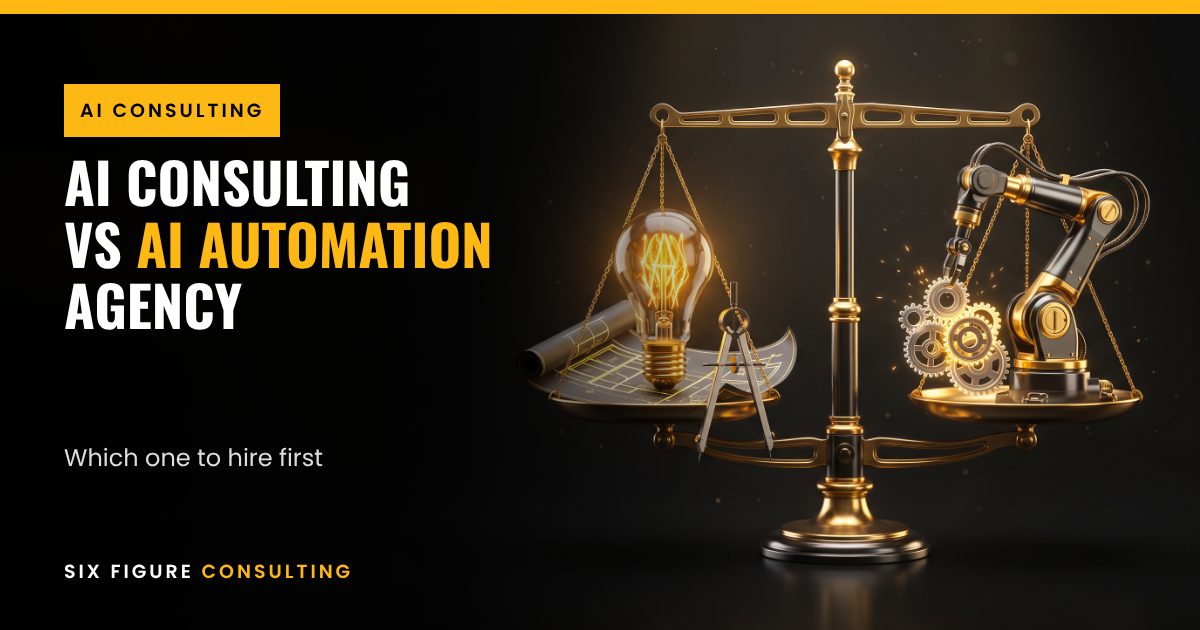
An AI consulting company decides what you should automate and in what order; an AI automation agency builds, tests and runs the automation. Hire consulting when you have many ideas and no clear first project. Hire an agency when a process is already chosen and documented. Most businesses need both, in that sequence.
This guide gives you the comparison, the decision rules, and the working documents each side should hand over, so you can act without us: a scoring matrix, process map, ROI model, readiness checklist, roadmap, governance checklist, build spec, acceptance tests, handover pack and monitoring plan. New to the term "agent"? Read what an AI agent is first. Already decided to build and choosing a vendor? Go to how to choose an AI automation agency.
Our position, stated plainly: we at SFC do both consulting and building, so we benefit when you hire us for both. Price that conflict of interest in. The protection is that every document below is one you can request in writing from any firm, including us. A consultant whose plan only that consultant can build has given you a sales funnel, not a plan. Make the plan portable.
AI consulting company vs AI automation agency: the definitions
Define each firm by what it produces, not by what it calls itself.
- AI consulting company: its main product is a decision. It studies your processes, data, people and risks and delivers documents saying which projects to run, in what order, how to measure them and what to avoid. The output is a plan you own.
- AI automation agency: its main product is a working system. It takes a defined process and delivers workflows, agents, integrations and the test, monitoring and handover material around them.
- Hybrid firm: does both under separate scopes. Most small and mid-size firms sit here, including us.
The practical test: ask each firm "what file or system will I be holding at the end?" A consultant answers with documents. An agency answers with a running system in accounts you control, plus the documents that let someone else operate it.
Side-by-side comparison
| Dimension | AI consulting company | AI automation agency |
|---|---|---|
| What it does | Finds and ranks opportunities, designs the approach, defines success and risk limits | Builds, tests, deploys and often operates the automation |
| Deliverables | Process maps, scored list, ROI model, readiness findings, roadmap, governance rules, build-ready briefs | Working workflows or agents, build spec, acceptance test results, handover pack, monitoring set-up |
| Who builds | Usually nobody; you or an agency builds | Automation engineers and operators, often with a project lead |
| How it is paid | Typically a fixed fee per phase or time-boxed days; sometimes monthly advisory | Typically a fixed build fee per scoped project, plus an optional monthly fee to run it; tool and AI usage costs are normally paid by you directly to providers |
| Main risk | Documents in a drawer; no accountability for results; a plan only the author can build | Automating the wrong process well; scope creep; a system nobody on your side understands |
| Wrong choice when | You already know the one process and it is documented; you want something running | You cannot say which process matters, who owns it, or what good looks like |
| Best signal of quality | Recommends things not to automate, and explains why | Shows acceptance tests and a handover pack before you sign |
Which one do you need first? Decision rules
Work through these in order and stop at the first one that applies.
- You can name one process, its owner, how often it runs and what a correct result looks like: hire an automation agency. Give them your process map (Asset 1) and ask for a build spec (Asset 8).
- You have a list of ideas but cannot rank them: buy a short diagnostic, or run the scoring matrix (Asset 3) yourself this week. Ranking is a half-day exercise for a small team.
- The process exists only in people's heads: map it first. Nobody can automate something nobody can describe. Use Assets 1 and 2.
- Your data is scattered across personal inboxes and spreadsheets, or system access is unclear: fix readiness first (Asset 4). That is consulting-shaped or internal work, not a build.
- The process touches regulated data, money movement, hiring decisions or legal commitments: start with governance (Asset 7) and an adviser who can set limits before anything is built.
- You already have a plan from someone else, or none of the above fits: hire an agency and test the plan with the handoff checklist, or follow the 30-day plan below and bring in help only where you get stuck.
- Leadership wants "an AI strategy" but nobody owns an outcome: hire consulting, and insist the output is a roadmap with named owners and measures, not a deck about trends.
This follows a principle in Anthropic's engineering guidance on agents: find the simplest solution that works and add complexity only when it measurably helps, which is often a single step or fixed workflow rather than an autonomous agent. A good consultant protects you from over-engineering; a good agency tells you when a simple workflow beats an agent. (Source: Anthropic, "Building effective agents", accessed 6 November 2026.)
The decision path in six steps
This is the path in the video. Run it alone, with a consultant, or with an agency.
- Map: list the candidate ideas and document the top processes (Assets 1 and 2).
- Score: rank the ideas, check readiness and model the benefit (Assets 3, 4 and 5).
- Choose: pick who builds, write the roadmap and set the risk limits (Assets 6 and 7).
- Brief: write the build spec and acceptance tests before kickoff (Assets 8 and 9).
- Pilot: build small, in your accounts, with human checkpoints on.
- Hand over: receive the handover pack and run the monitoring plan (Assets 10 and 11).
Step 1: Map the process
Write one line for each automation idea your team has; aim for 10 to 15. Then document the processes that score best (Step 2 tells you which). A process map is the single document an agency needs most, because it records how work actually happens, including the awkward exceptions.
Asset 1: Process-mapping template (one map per process)| Field | What to write |
|---|---|
| Process name and owner | One sentence of purpose; the one person accountable |
| Trigger | What starts it (an email, a form, a date, a deal stage) |
| Volume | Runs per week, with busiest and quietest weeks |
| Steps (one row each) | Step number, what happens, who does it, system used, minutes per run, how often it goes wrong, cost of an error (low, medium, high), data needed and where it lives |
| Decision points | Each "if X then Y", with the rule written down |
| Exceptions | The five most common odd cases and how humans handle them today |
| Output | What a finished run looks like, and who receives it |
| Definition of correct | How a reviewer decides a result is right |
As a spreadsheet, use these columns for the steps: Step | Description | Owner | System | Minutes per run | Error rate (rough) | Error cost (L/M/H) | Data needed | Data location | Decision rule | Automate? (yes / assist / no). Mark each step "yes" (software does it), "assist" (software drafts, a person approves) or "no" (a person does it). Most steps should not be fully automated.
Use this to interview the person who actually does the work, one question at a time, writing their answers straight into Asset 1.
| Order | Ask | Write it down as |
|---|---|---|
| 1 | What starts this process, and how often does it run? What does a finished result look like, and who gets it? | Trigger, volume and output |
| 2 | Walk me through it step by step. Who does each step, in which tool, and how long does it take? | One row per step with minutes (a range, labelled "estimate" if unsure) |
| 3 | Where do you make a choice, and what exactly decides it? If they say "it depends": on what? Ask for one real example. | Decision rule, with the example |
| 4 | What mistakes happen most, and how are they caught? | Error rate and error cost |
| 5 | What are the five oddest cases you handle? | Exceptions list |
| 6 | How would a reviewer know the result is right? | Definition of correct |
Write "unknown" for anything the person did not state; never fill gaps with your own guesses. Check it worked: hand the finished map to a colleague who does not know the process. If they can explain the steps back and name one exception correctly, it is detailed enough.
Step 2: Score the ideas, check readiness, model the benefit
Opportunity scoring matrix
Score every idea from 1 to 5 against seven criteria. Multiply each score by its weight (weights add to 100), add them up and divide by 5 for a score out of 100. Have two people score independently, then reconcile. The gate matters most: a risk score of 1 removes an idea from the first wave whatever its total.
Asset 3: Opportunity scoring matrix| Criterion | Weight | Score 1 (weak) | Score 3 (medium) | Score 5 (strong) |
|---|---|---|---|---|
| Volume and frequency | 20 | A few times a year | Weekly | Daily or many times a day |
| Effort saved per run | 15 | Seconds of human time | Around 10 to 20 minutes | An hour or more, or blocks other work |
| Rule clarity | 15 | Judgement call; experts disagree | Mostly rules with known exceptions | Clear rules a new hire could follow from a checklist |
| Data availability | 15 | On paper, in heads, or inaccessible | Exists but needs cleaning or manual export | In one or two systems with export or API access |
| Risk if wrong (5 = low risk) | 15 | A mistake harms a client, money, legal standing or a person | A mistake costs rework and is caught before it leaves the building | A mistake is cheap, reversible and internal |
| Measurability | 10 | No baseline and no way to count it | Can be estimated from samples | Already counted in a system or report |
| Owner and adoption readiness | 10 | No owner; team resists | Owner exists but is busy | Named owner who wants it and will review output |
Spreadsheet formula: =(S1*20 + S2*15 + S3*15 + S4*15 + S5*15 + S6*10 + S7*10) / 5, with S1 to S7 the seven scores in table order. Reading it: 75 and above is a first-wave candidate; 55 to 74 is for later or after a readiness fix; below 55 is parked. Gates: a risk score of 1 means not in the first phase; a data score of 1 means fix readiness first. These thresholds are our working defaults, not an industry standard. Default to a single step or fixed workflow; choose an agent only when the steps cannot be predicted in advance.
AI readiness checklist
Readiness is a list of blockers, not a score. Google Cloud's AI Adoption Framework, for example, is organised around people, process, technology and data. (Source: Google Cloud blog on its AI Adoption Framework, accessed 6 November 2026.) We use those four areas plus risk, with concrete questions.
Asset 4: AI readiness checklist| Area | Question (yes, partly or no) | If "no", the fix |
|---|---|---|
| Data | Is the data stored in a system, not in personal inboxes or paper? | Move it into a shared tool before building |
| Data | Can we export it or reach it by API, with permission? | Get admin access or choose a different process |
| Systems | Do our tools (CRM, email, accounting, helpdesk) allow integrations on our plan? | Check plan limits with each vendor; budget an upgrade or choose another route |
| People | Is there one named owner, with weekly time to review output? | Assign one and block the time, or delay the project |
| Process | Is the process written down, with exceptions? | Complete Asset 1 first |
| Risk | Do we know the worst mistake and who is told? | Complete Asset 7 for this process |
Three or more "no" answers in the Data or Systems rows means fix those first. It is cheaper to discover this before a build quote than after.
ROI model template
Before any build, write down what changes and how you will know. We leave the numbers blank on purpose: your figures come from your own baseline, and invented benchmarks mislead. Mark each input "measured" or "estimate".
Asset 5: ROI model templatePROCESS: <NAME> OWNER: <NAME> DATE: <DATE>
INPUTS (mark each "measured" or "estimate")
R = runs per month = <R>
T = human minutes per run today = <T>
T2 = human minutes per run after (review only) = <T2>
C = loaded cost per human hour = <C>
E = errors per month today = <E>
K = average cost of one error = <K>
E2 = expected errors per month after = <E2>
B = one-time build cost (fee plus your own time) = <B>
M = monthly running cost (tools, AI usage, support) = <M>
FORMULAS
Hours saved per month = R * (T - T2) / 60
Labour value per month = Hours saved per month * C
Error value per month = (E - E2) * K
Net monthly benefit = Labour value + Error value - M
Payback (months) = B / Net monthly benefit (only if Net is above zero)
ASSUMPTIONS AND RISKS (at least three)
1.
2.
3.
DECISION RULE
Proceed if payback is within <YOUR_THRESHOLD> months AND the owner confirms
the freed time will be used on named work. If nobody will redeploy the freed
time, treat the labour value as zero.That last rule is the one most models miss. Time saved is only money if the hours are reused or a hire is avoided. A consultant who shows savings without naming where the hours go has handed you a hope, not a model.
Step 3: Choose who builds, then set the limits
Apply the decision rules above. Then record the choice in a roadmap and the risk limits in a governance checklist. Put an idea in "Now" only if it passes the gates, has an owner and can be built in a short cycle. Keep "Now" to one or two items: the goal is a working result, not a portfolio.
Asset 6: Roadmap template (now, next, later)ROADMAP Business: <NAME> Version: <DATE> Review date: <DATE>
NOW (build in the next cycle; maximum 2 items)
Item: <PROCESS> Score: <N> Owner: <NAME>
Pattern: single_step | workflow | agent
Human checkpoint: <WHERE A PERSON APPROVES>
Success measure: <METRIC AND TARGET YOU SET> Baseline: <MEASURED VALUE>
Dependencies: <ACCESS, DATA FIXES, DECISIONS>
Build owner: internal | agency | consultant-supervised
Stop rule: if <CONDITION> by <DATE>, pause and review.
NEXT (start after the Now items pass acceptance tests)
Item / Score / Owner / Dependency on Now item
LATER (needs a readiness fix or a result from Now first)
Item / Score / Blocker
NOT NOW (and why)
Item / Reason: RISK GATE | DATA GATE | NO OWNER | NOT WORTH IT
REVIEW LOG
Date | What we learned | What moved between columnsGovernance for a small business needs no committee, only written answers before anything touches real customers or money. This is our plain-language version for small teams and is not legal advice.
- Accountability: one named person owns each automated process and signs off changes.
- Human checkpoints: a list of actions that always need approval (first contact with a customer, anything involving money, hiring decisions, legal commitments, regulated advice).
- Data rules: what the AI may see, what is masked, where data is stored, who has access, how long it is kept.
- Vendors: for each tool and AI provider, you have read its data-use and retention terms and recorded the plan you are on.
- Accuracy rules: the system says "unknown" instead of guessing, and shows where a fact came from.
- Kill switch: you know how to pause the automation in one step, and who may.
- Audit trail and transparency: every automated action is logged and readable by a non-engineer; customers can tell they are dealing with automation, can reach a person, and can opt out immediately.
- Review cadence: a recurring date to review samples, errors and complaints.
- Local rules: data-protection and messaging rules differ by country and sector; confirm what applies with a qualified adviser.
Engagement structures
Firms sell four shapes of work: a short diagnostic (a scored shortlist and recommendation; risk: generic findings, so require Assets 1, 3 and 6 and ask for samples), a roadmap engagement (readiness, ROI and governance across teams; risk: over-planning, so detail only the next two quarters), a pilot build (one scoped project with tests and handover; risk: it cannot scale or hides costs, so fix scope, a stop rule and a cost model), and a retainer (ongoing operation or advice; risk: paying for activity, so review monthly against Asset 11 and write exit terms in advance).
Google Cloud's account of its own AI rollout makes a related point: launch a narrow first version quickly, learn from real use, and measure outcomes rather than activity. (Source: Google Cloud, "Beyond the pilot: five hard-won lessons", accessed 6 November 2026.) A pilot with a stop rule applies that advice; a retainer without a measure does the opposite.
Step 4: Brief the builder
If you hire an agency, these four items are the contract in practice: a build spec, acceptance tests, a handover pack and a monitoring plan. Write them yourself, or check an agency's versions against the templates. Anthropic's guidance on building tools for agents describes a loop worth copying: prototype quickly, test against realistic tasks with a checkable outcome for each, then read the results and refine. (Source: Anthropic, "Writing effective tools for AI agents", accessed 6 November 2026.) Your acceptance tests are that loop, written down before the build begins.
What the consultant's output must contain so an agency can build
Most duplicated spending happens at this seam: the consultant writes a report, then the agency runs its own discovery because the report is too vague to quote from. Require the consultant's pack to pass this checklist.
- A process map in the Asset 1 format, with minutes per step, decision rules and exceptions.
- A named owner and approver on your side.
- 10 to 20 anonymised real examples with the correct outputs (a "golden set"), which become the agency's test data.
- Systems, plan levels and access status (who can grant admin access, and has it been requested).
- The pattern decision (single step, workflow, agent) and the reason.
- Human checkpoints and risk limits from Asset 7.
- Success measures with a measured baseline, and the scoring record showing why this project is first.
- Out-of-scope items, written explicitly, and a draft of Asset 8 with blanks marked.
To avoid paying twice for discovery: ask before hiring whether the consultant's deliverables meet this checklist; make the contract say the maps, scoring and briefs are yours and portable; give the agency the pack and ask for a gap list rather than a restart (a full second discovery phase is a red flag unless the pack was weak); ask the agency to credit any discovery against the build fee, or quote a build without it; and if one firm does both, ask for the consulting scope as a separately priced deliverable with no obligation to continue.
Asset 8: Build spec templateBUILD SPEC Version: <N> Date: <DATE>
Client owner: <NAME> Build lead: <NAME> Approver: <NAME>
1. PURPOSE One sentence: what this does and for whom.
2. SCOPE In scope: <LIST> Out of scope (explicit): <LIST>
3. TRIGGER AND INPUTS
Trigger: <WHAT STARTS EACH RUN>
Inputs: field | source system | format | required? | example
Attach at least <N> real, anonymised examples.
4. PROCESS DESIGN
Pattern: single_step | workflow | agent (one-line reason)
Steps (input, action, output, who performs it); every if/then rule; human checkpoints
5. OUTPUTS Output | destination | recipient; what happens when the system is unsure
6. QUALITY RULES Use only provided information; "unknown" instead of guessing; no customer contact without a checkpoint
7. SYSTEMS AND ACCESS System | account owner | access level | credential storage (client-owned accounts only)
8. ERROR HANDLING Failure | detection | response | who is alerted
9. DATA AND PRIVACY Data | classification | masked? | retention | AI provider and plan
10. COST AND TIMELINE Build fee basis; monthly tool costs (client pays providers); milestones
11. ACCEPTANCE Complete when every test in Asset 9 passes.
12. CHANGE CONTROL AND HANDOVER Changes after sign-off in writing and approved first; handover per Asset 10.ACCEPTANCE TESTS System: <NAME> Version: <N> Tester: <NAME>
Every test is a MUST: any failure blocks sign-off.
FUNCTION
[ ] T1 Run 20 real, anonymised examples; reviewer marks each correct / acceptable / wrong.
Agree the pass threshold BEFORE the run: <YOUR_THRESHOLD>.
[ ] T2 Run 5 known edge cases from the process map; each ends correct or in a safe hold.
[ ] T3 Run 3 inputs with missing fields or confusing data (duplicate record, wrong language); the system writes "unknown" or holds, never guesses, and no bad output reaches a customer.
SAFETY
[ ] T4 Human checkpoints fire where the spec says.
[ ] T5 The kill switch pauses the system in one step; nothing runs after.
[ ] T6 A "stop" request is honoured immediately (if the system contacts people).
OPERATION
[ ] T7 A connected system failing alerts the named person with no silent data loss.
[ ] T8 The log shows time, input, output and decision for every run, readable by the owner.
HANDOVER
[ ] T9 The client owner changes one setting using only the handover pack, and a second person can pause, resume and read the log.
SIGN-OFF Results | open issues | agreed fixes and dates | signed (client owner) | signed (build lead)Step 5: Pilot with human checkpoints
Here is the sequence we recommend when you will use both consulting and building, from one firm or two. Durations are a planning shape, not a promise.
- Weeks 1 to 2, diagnostic: inventory, score, map the top three, check readiness.
- Week 3, decision: choose the first project, agree measures and baseline, write the roadmap.
- Week 4, spec and quote: the build lead drafts Asset 8 from your pack; you review; scope and price are signed against it.
- Weeks 5 to 7, pilot build: built in your accounts, tested on the golden set, human checkpoints on, stop rule written.
- Week 8, acceptance and handover: sign off, receive the handover pack, switch on monitoring.
- Weeks 9 to 12, run and learn: weekly sample reviews against the baseline, then scale, change or stop.
If you are weighing the whole-stack option, our Build Your AI Team page describes how we build several agents together; do not buy that before one pilot has passed acceptance. For an early, defined first step, the strategy-plus-automation option on our packages page is designed for the "not sure where to start" case. Compare its deliverables to the checklists here, as you should for any firm. For a sales-side example of the same build-versus-hire question, see AI SDR vs human SDR.
Step 6: Hand over and monitor
Asset 10: Handover pack contents- A one-page overview: what the system does, what it does not do, who owns it.
- Every account, tool and integration, with the owner and plan of each.
- The final build spec, process map, acceptance test results and test examples, so tests can be re-run after any change. Plus contacts and what happens if the agency relationship ends.
- A runbook: pause, resume, re-run a failed item, roll back a change.
- The monitoring plan (Asset 11) and where the report lives.
| What to watch | How | How often | Who | Trigger to act |
|---|---|---|---|---|
| Run successes and failures | Workflow tool run history | Daily at first, then weekly | Process owner | Any unexplained failure |
| Output quality | Sample reviewed against the "definition of correct" | Weekly for a month, then monthly | Process owner | Wrong rate above the threshold set in testing |
| Items held for review | Count and age of the queue | Weekly | Process owner | Queue growing, or items waiting past target |
| Upstream changes | Changes to forms, CRM fields, AI model versions or plans | On change | Build owner | Any change; re-run tests T1 to T3 |
Review on a fixed weekly schedule for the first month and change one thing at a time, so you know what caused a movement. Three numbers tell you most: the acceptance pass rate (tests passed first time over tests total), the correct-result rate on sampled outputs, and review burden (if checking takes as long as the original work, simplify or stop). Compare measured net benefit with your Asset 5 forecast and update the assumptions before the next project.
A worked example (illustrative)
This example is illustrative. The company and its numbers are fictional, and the scores are invented to show the method. They are not a client result.
Cedar and Rowe Advisory is a fictional 14-person B2B consultancy. The managing partner wants to "use AI" and has a pile of ideas from the team. She and the operations lead score eight of them with Asset 3. Columns: Volume, Effort, Rules, Data, Risk (5 = low risk), Measure, Owner.
| Idea | Vol | Eff | Rules | Data | Risk | Meas | Own | Total /100 | Gate |
|---|---|---|---|---|---|---|---|---|---|
| Summarise discovery calls into the CRM | 5 | 3 | 4 | 4 | 4 | 4 | 5 | 83 | none |
| Chase overdue invoices (draft reminders) | 4 | 3 | 5 | 5 | 3 | 5 | 4 | 82 | none |
| Qualify inbound website enquiries | 4 | 3 | 4 | 4 | 4 | 5 | 4 | 79 | none |
| Meeting scheduling and reminders | 4 | 2 | 4 | 4 | 5 | 4 | 4 | 77 | none |
| Draft proposals from call notes | 4 | 4 | 3 | 4 | 3 | 4 | 4 | 74 | none |
| Screen CVs for hiring | 2 | 3 | 3 | 3 | 1 | 3 | 2 | 48 | not in first phase |
| Answer client questions in chat unattended | 3 | 3 | 2 | 2 | 1 | 2 | 2 | 44 | not in first phase |
| Auto-negotiate contract terms | 1 | 2 | 1 | 2 | 1 | 1 | 1 | 26 | not in first phase |
Check one row by hand: call summaries score (5x20 + 3x15 + 4x15 + 4x15 + 4x15 + 4x10 + 5x10) / 5 = (100 + 45 + 60 + 60 + 60 + 40 + 50) / 5 = 415 / 5 = 83.
The reasoning. Three ideas fail the risk gate: CV screening touches people's livelihoods, unattended client chat could give wrong advice under the firm's name, and contract negotiation is a legal commitment. They go on the "not now" list with those reasons, whatever the total. The top two have clear rules, accessible data and a named owner; she picks them as the first wave but builds one at a time.
Roadmap (from Asset 6):
- Now: discovery-call summaries into the CRM (83). Pattern: a single step inside a fixed workflow. Checkpoint: the account lead edits and approves each summary. Measure: share of calls with a complete CRM record within a day, against a two-week baseline. Stop rule: if a third of sampled summaries need major edits after four weeks, pause and revisit the rules and inputs.
- Next: overdue-invoice reminders (82), drafted for approval and never sent automatically; then inbound enquiry qualification (79).
- Later: proposal drafting, after the first build proves the review habit.
- Not now: CV screening, unattended client chat, contract negotiation (risk).
First build spec (summary of Asset 8): the spec for call summaries has a one-sentence purpose (a structured summary and draft CRM update for the account lead to approve), explicit out-of-scope items (sending anything to the prospect, scoring the lead, changing deal stage), 15 anonymised past transcripts as the golden set, and a fixed workflow: fetch the transcript, extract fields, check that every field has a quote or the value "unknown", save a draft marked "DRAFT", notify the account lead. Quality rules: never infer budget or authority. Acceptance: Asset 9 tests T1 to T9 pass on the golden set.
No one needed to pick a vendor or tool first. The decision comes before the build.
Pre-hire QA checklist
Run this against any consulting company or automation agency, including us, before you sign.
- Scope and deliverables are in writing, with out-of-scope items listed.
- The firm asked specific questions about my processes before quoting, and told me at least one thing I should not automate.
- I own the documents and the systems; builds live in my accounts and I hold admin access.
- Acceptance criteria are agreed before the build, with a named sign-off person.
- Human checkpoints and a kill switch are part of the design.
- Handover material is a contract deliverable, not an add-on, and exit terms say what I receive if we stop at any phase.
- If one firm does both, the consulting scope is priced separately and is portable.
Common mistakes and fixes
| Mistake | Why it hurts | Fix |
|---|---|---|
| Buying a build before choosing the process | You automate whichever idea was loudest | Score candidates with Asset 3 first |
| No acceptance tests or monitoring | "Done" means whatever the builder says, and quality drifts | Agree Asset 9 before kickoff; run Asset 11 from day one |
Your 30-day plan
- Days 1 to 2: list every candidate idea (10 to 15), one line each.
- Days 3 to 4: score them with Asset 3, two people independently, then reconcile. Apply the gates.
- Days 5 to 7: pick the top three; interview each owner with Asset 2 and complete the maps (Asset 1).
- Days 8 to 10: run the readiness checklist (Asset 4) for the top one; fix what you can, note the rest.
- Days 11 to 13: measure the baseline and fill the ROI template (Asset 5).
- Day 14: complete the roadmap (Asset 6) and governance checklist (Asset 7). Decide: build yourself, hire an agency, or bring in a consultant for the gap.
- Days 15 to 18: draft the build spec (Asset 8) and acceptance tests (Asset 9). If hiring, send the pack to two or three firms and compare their questions and gap lists.
- Days 19 to 28: pilot on a small sample, run the tests, adjust, then run with human checkpoints on.
- Days 29 to 30: compare with the baseline, set up the monitoring plan (Asset 11), update the roadmap, and decide to scale, change or stop.
Frequently asked questions
What is the difference between an AI consulting company and an AI automation agency?
An AI consulting company decides where AI fits, in what order and with what safeguards, and delivers documents such as a scored opportunity list and a roadmap. An AI automation agency builds, tests and often runs the workflows or agents, and delivers a working system with a handover pack. Some firms do both under separate scopes.
Should I hire an AI consultant or an automation agency first?
If you can name one process, its owner and what a correct result looks like, hire the agency and give it a process map. If you have many ideas and cannot rank them, or the process is not written down, start with consulting or run a scoring matrix yourself. Ranking ideas is a half-day exercise for a small team.
How do I avoid paying twice for discovery?
Require the consultant to deliver build-ready documents: a process map with minutes per step, decision rules, exceptions, a set of real anonymised examples, systems and access status, risk limits and success measures. Own those documents, give them to the agency to quote from, and ask for any duplicate discovery to be credited or removed.
Can one company do both consulting and building?
Yes, and many do, including SFC. The benefit is that the plan is written by people who must build it. The risk is a plan that only that firm can execute. Ask for the consulting scope to be priced separately, delivered in portable documents, and carry no obligation to continue.
What should an AI automation agency give me at the end of a project?
At minimum a written build spec, acceptance test results against criteria agreed before the build, a handover pack so your team can pause, change and read logs without the agency, and a monitoring plan. The system should live in accounts you own, with admin access held by you.
How do I know whether an AI consulting company is worth hiring?
Ask for sample deliverables before signing. Good signs are specific questions about your processes, a written list of deliverables, a scoring method you can see, and a recommendation that includes things not to automate. Be cautious of anyone who promises results before seeing your processes or who cannot show a portable plan.
Sources and further reading
- Anthropic, "Building effective agents" (start with the simplest solution; workflows versus agents; common workflow patterns). Accessed 6 November 2026.
- Anthropic, "Writing effective tools for AI agents" (prototype, evaluate with realistic tasks, iterate). Accessed 6 November 2026.
- Google Cloud, AI Adoption Framework (people, process, technology and data; maturity phases). Accessed 6 November 2026.
- Google Cloud, "Beyond the pilot: five hard-won lessons" (task-focused design, narrow first versions, measuring outcomes). Accessed 6 November 2026.
- SFC delivery SOPs (methods adapted and anonymised).
What to do next
If you already know you want agents built rather than mapped, see our AI automation agency page. Otherwise, start today with the cheapest step: list your candidate ideas and score them with Asset 3. If you would like a second pair of eyes on the shortlist, or want the first project specified and built in your own accounts, see the SFC packages, or book a short call and bring your scored list. We will tell you plainly if the right next step is to build, to map the process first, or to do nothing yet. If your first project is lead generation, our guide to AI agents for lead generation walks through a full build, and the guide on choosing an AI automation agency covers the vendor questions in more depth.